Blended Custody Suggested Solutions
Blended Custody is when the kids will be shared and primary care. Example: Three kids, two will be shared and one will be primary care. The Guidelines do not address this situation so we put together some samples of how we would address these situations.
Click on the "Special Ops" button and you will see a link to our blended calculator feature.
Possible arguments for the examples below. In shared care cases, the guidelines take into account that both parents must maintain a home to care for the children. When you have blended, you don't have a shared care case for all the kids, but if for at least one child, both parents must maintain a home.
It is important to be mindful that the first child, in any calculation, will always have the greatest value. Example: Three kids. Child support for 3 is $1,000 per month, for 2 kids $900 per month and for 1 child $800 per month. Under the "Special Ops" button, there is a feature called "Tax Effects" and you can see how it works.
First, I would like to thank P. Shawn McCann, Esq. from Council Bluffs, for keeping me on my toes in this arena.
Blended Sample Case: 2 children - 1 Shared Custody - 1 Primary Care
IMPORTANT: Make all the entries to be made. Since there are two children involved, both parents will file Head of Household. Make the parent who will have primary care of the one child as the Custodial Parent.
Steps:
1. Assuming you have made all the entries necessary into the program as they should be, indicate that there are two children at issue. Do not check the shared custody box.
2. Go to Form 1. Look at Line J on page three. This will show you the amount, per month, what the NCP must pay in support.
3. Divide the amount from Step 2 by two. This will tell you the average amount of child support for each child. This will comprise part of the amount of money the non-custodial parent must pay to the custodial parent for the child in primary care. That is the average cost of the two kids as though both are in primary care.
4 Enter the result of step 3 here for the average cost of the primary care child: ___________
Next, you must determine the support involved for the child in joint physical care.
5. Check the "shared care" box.
6. Open Form 1 and go to Line K on page 3. This will show you the support owed by parent with the higher income. Divide that number in half and that is the amount owed by that parent to the other, as an average, of the two kids.
7. Enter the result from step 6 here: _________.
Do the math between 4 and 7 to come with the final total tally. This is your result. br>
Remember, you must perform a step-down. Iowa Support Master has no idea what will change when one of the kids drops off. It doesn't know which child is in the primary care of a party, if that is the oldest or youngest child.
Please keep in mind that if there are results displayed, they were prepared by an older version of Iowa Support Master. Your numbers won't match. We are showing you how we suggest you run the calculations.
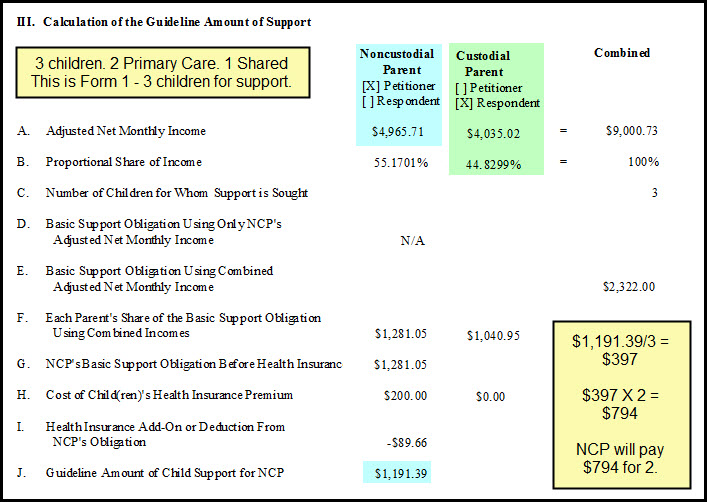
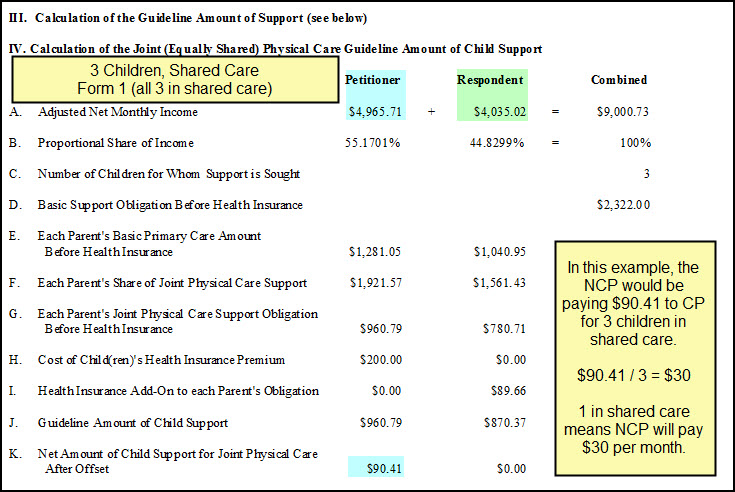
Example Case: 3 Children - 1 Shared Custody - 2 Primary Care
Read then see the images directly below.
Enter all of the financial information into Iowa Support Master as though you are preparing a normal Form 1.
Since the parties will have shared custody of one, make both parties will be Head of Household.
Go to number of children for support and enter 3. The resulting child support amount we will call X. Write this number down or print the Form 1 or print the Analysis Page. Make sure that you mark X at the top of the Analysis Page.
Return to the number of children for support screen and check the "Shared Physical Care" box. The resulting child support amount we will call Y. Print Form 1 or the Analysis Page. Mark Y at the top of the page.
Divide X (primary care support for 3) by 3 (total number of children). This will give you a value for each child in primary care. Multiply the result by 2 to show you how much support must be paid for the two children in primary care. (Compare this number to what the support would be for two children in a regular calculation, not shared care).
Divide Y (shared physical care support for 3) by 3 (total number of children). This will give you the value for each child in shared physical care. This result will tell you what the one parent must pay the other for the shared physical care of the 1 child.
Logic. First, we know that in all cases, the value of the first child is always higher than the 2nd child. And the value of the 2nd child is higher than the 3rd child. You can see this under our "Special Ops" feature. We are also mindful that in a regular, joint custody, primary care with one party, that the costs of maintaining the home for the children by the custodial parent are given great consideration. In shared physical care, the Guidelines take into account that both parents must maintain a home for the children so that is also taken into account.
Using the above method creates a result that equalizes the value of each child amongst the three. The shared care parent must also maintain a home and should not be expected to shoulder a much greater burden paying the other parent who will be primary caretaker of the 2 children. Making the value of each child equal helps to reduce the burden while still recognizing that the primary care custodian has a greater burden in caring for the two children.
If the parties have two children with 1 primary and 1 shared, you could use the same method above.
Another Method - Example Case: 2 children - 1 Shared Custody - 1 Primary Care
Terry has income of $50,000 and will have shared care of one child.
Lynn has income of $30,000 and will have shared care of one child and primary care of the remaining child.
Terry claims one child and head of household status.
Lynn claims one child and head of household status.
Terry pays $130 per month for health coverage on the children.
There are 2 children for support purposes.
Form 1 says the basic support obligation with cost of health insurance is $1,581.00 per month.
Lynn's share of income is 37.86%
Terry's share of income is 62.14%
Divide the $1,581.00 total support amount in half (2 kids): $790.00
Terry must pay Lynn 62.14% of $790 for the primary care child: $491.00
Go back into the program.
Give Terry 1 exemption and Head of House status.
Give Lynn 0 exemptions and Single filing status.
Change the number of support children to 1.
Check the Shared Physical Care button.
Result is Terry has a support obligation to Lynn in the amount of $167.13
Total obligation by Terry to Lynn $491 plus $167 = $658.00
Logic:
If we did a straight calculation of Terry paying Lynn support for 2 kids, each claiming one, Lynn filing HoH and Terry filing single, Terry would pay $834 per month.
If we did shared care for 2 children, each claiming one, both filing HoH, Terry would have an obligation of $215 per month.
If we did a straight calculation of Terry paying Lynn support for 1 child, primary care, Terry claims the child and files single. Lynn files as HoH, Terry would pay Lynn $578
The total obligation by Terry using this formula is $658.00 per month.
$658 is $80 more than Terry would pay Lynn if Lynn had primary care of one child. This means that Terry is paying an extra $80 to Lynn for the shared care child.
$658 is $176 less than what Terry would pay Lynn if Lynn had primary care of 2 children. This means that Lynn is paying Terry $176 for her share of the shared care child that Terry would have.
Another Method - Example Case: 4 children - Mom will have primary care of 2 and the parties will have shared care of the other 2
Step 1: In Iowa Support Master, put the party who will have primary care of children in the CP position.
Step 2: Enter all financial information into the program, including who will claim the kids, filing status, income, cost of health insurance, etc.
Step 3: Select the total number of children for support purposes.
Step 4: Record the resulting support figure. In the usual primary care case, this is what NCP would be required to pay CP in support for all of the children without taking into consideration that some of the children will be shared.
Step 5: Divide the support amount from Step 4 by the number of children in your case. Multiply the result against the number of children that CP will have primary care of. This will be result X.
Step 6: Go back into the program Iowa Support Master and change the number of support children to the number of children that will be shared custody.
Step 7: Check the Shared Custody box.
Step 8: Record the resulting support figure. This result will be what the parent having the greater income must pay to the other in the shared care calculations. If it is the same parent who must pay X from Step 5, add X to this amount and that is what the parent must pay the other in support. If it is not the same parent who must pay X from Step 5, you must subtract this amount from X in Step 5 to arrive at the proper support amount.
You will need to recalculate for all future changes as the kids drop off. It is impossible for the program to know which children will drop off first.
Logic
The Child Support Guidelines Committee found that in shared custody cases, both parents bear an added burden of providing for the children that are in shared care. That doesn't change just because one parent might have primary care of 1 child while the parties have shared care of 5 children.
The calculations in shared cases take into account these added costs by granting credit in the calculations. Look at the support grids at Rule 9.14(3) Guidelines, lines F and G.
The first child in any primary care support case is 75% or more of the burden when there are multiple children involved in a case. This can be shown by calculating child support as though there is only one child. Note the support amount then change the number of support children to 2. Compare the support result to the to the support amount when only one child is involved. Increase the number of support children to 3. As you continue, you will find that the addition of each child after the first is a fraction of the value of the first child.
The calculation formula above takes this sliding scale out of the equation by making the value of each child equal. We have done so because of the nature of the parties sharing the care of some of the children. Without doing so, you would have a parent paying a hefty price of support for the primary care children while having the burden of sharing care of other children.