Watch and learn in 2 minutes: Pension Calculations Video
Watch our YouTube video on IPERS contributions (with sound): IPERS Calculations Video
Pension contributions, voluntary or mandatory, are not allowed as deductions against income with one exception.
Authority: Rule 9.14(1) Adjusted Net Monthly Income then look at paragraph D. "Social Security and Medicare tax/mandatory pension
deductions (For employees not contributing to Social
Security, mandatory pension deductions shall not exceed the
current Social Security and Medicare tax rate for
employees.)"
The exception is that if the party is not paying into Social Security and Medicare, they are allowed to claim the pension contribution up to the current FICA rates. See the FICA topic below. One example we know of is Iowa State Highway Patrol Troopers. They have their own retirement and are not subject to FICA.
Very Important! If you have a case where a party is paying into a pension fund, voluntary or mandatory, you must know the answers to two questions:
1. Is the party paying into Social Security/Medicare? Look at their pay stub for FICA contributions. If the party is paying into Social Security/Medicare, go to question number 2. If they are not paying into Social Security/Medicare, you must enter their income in the "Taxable Income ... No FICA" area of the income screen (found in the middle of the screen).
2. The party is paying into Social Security, and they are also contributing to a 401K or some retirment fund, voluntary or not. You need to know how much they are paying into that fund annually. So you know their wages that are reduced by the 401K contributions. Enter that income amount into the income screen as their income. Look lower on the Income screen for the "Other Income" fields. Type in "Pension Contribution" as the description then enter the amount they are contributing to their 401K. Uncheck all the boxes.
What does this do? This will add the pension money back into that party's income. This will raise their income because they are not paying taxes on this portion of their income. The Guidelines do now allow a party to reduce their income by making voluntary or involuntary contributions to a 401K.
Pension contributions are not subject to tax withholding. Taxes are charged when the person starts drawing funds out of their pension on retirement. The end result is that this money is added back in and credited to that party. If it is the non-custodial parent, this will increase his/her income and raise child support. If if is the custodial parent, it will have the opposite effect.
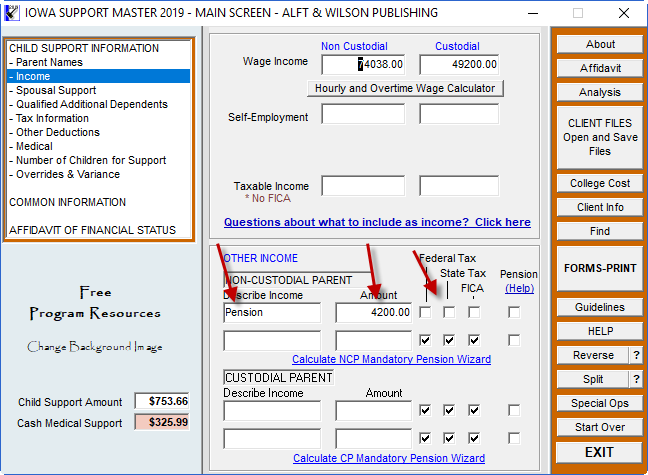
Example Case: Joe is an IPERS employee (teacher). He is also making contributions into another pension fund. He is also paying into Social Security/FICA. Look at his pay stub. Do the math to determine how much in a year he will contribute to IPERS and to the other pension fund. So let's say Joe earns $100,000 per year. His pay stub shows he is paying $6,290 into IPERS and another $6,000 into another pension fund. He is contributing $12,290 into pension. Those funds are not subject to tax. $100,000 minus $12,900 = $87,100. Enter $87,100 into the Wage Income Field. Go to "Other Income" and describe Income - IPERS $6,290 and uncheck all boxes. Enter 401K and $6,000 then uncheck all boxes. This will add these sums of money back into Joe's income.
IPERS Employees (this also works for Firefighters)
Click Here for help entering IPERS income into Support Master.
IPERS is a mandatory pension. Even so, an IPERS employee is not allowed to use their IPERS contributions to reduce their income if they are also paying into FICA (Social Security). Look at their wage stub. If you see that they are paying Medicare/FICA taxes on their income, AND, they are contributing to IPERS, they may not deduct their IPERS contribution. Iowa Support Master will help you with this. Continue reading.
See Guidelines Rule 9.5 Income. Rule 9.5(2) "Net monthly income......means gross monthly income less deductions for the following:" Rule 9.5(2)(c) "Social Security and Medicare tax deductions, or for those employees who do not contribute to Social Security, mandatory pension deductions not to exceed the current Social Security and Medicare tax rate for employees."
Example: Mary works as a teacher. Mary has an annual IPERS contribution of $4,000. Her employer also pays in $4,000 per year for her to IPERS. Mary also pays Medicare/FICA taxes.
Go to "Other Income" and for Mary, put in "IPERS Contribution" and the amount of $4,000. Uncheck all boxes as Mary is not paying taxes on her IPERS contribution. This will add the $4,000 IPERS contribution back into her income for the purpose of calculating child support. This drives up her income with resulting effects on child support. If you look at Mary's page of the Form 1, at the top, you will see notations of this money being added back in.
The employer's share of the IPERS contribution is not considered income to Mary. Mary will only receive the benefit of that money so long as she makes a contribution and the employer matches it. It is not considered income to Mary until she retires and draws it out of IPERS.