Income Help Page Quick Links
Adoption Subsidies
Child Support Received - income?
Child Receives Social Security
Earned Income Tax Credit
Farmers - What to do...
FICA
FICA How-to-Calculate
Firefighter Income
Imputed Income Defined
Incarcerated Parent Income
Income Not Subject to FICA
IPERS Explained - Calculator
IPERS on Form 1
Law Enforcement
Military Disability Income
Military Pay/Benefits
Other Income Field
Pension Benefits Received
Pension Contributions Mandatory/Voluntary
Pre-Tax Health Insurance Premiums
Public Assistance
Self-Employment Income
Social Security
Social Security Received by Dependents
Taxable Income - No FICA
Trust Fund Distributions
Unemployment Benefits
Veteran Disability Income
Voluntary Reduction in Income
Wage Income
Wages in Iowa and Other State
Gross Monthly Income Defined "reasonably expected income from all sources". Guidelines Rule 9.5 It does not necessarily mean just income you would report on a tax return.
"The Guidelines do not limit the definition of gross income to that income reportable for
Federal Income tax purposes. Although veterans' disability benefits, social security
disability or retirement payments and worker's compensation benefits are exempt from
federal taxes, they are properly considered as income in determining if a substantial change
in circumstances has been established and in determining the amount of child support. See
In re Marriage of Howell, 434 N.W.2d 629, 633 (Iowa 1989) (Veterans' Retirement and
DisabilityBenefits); In re Marriage of Stuart, 252 N.W.2d 462 (Iowa 1977) (Social Security
Disability Payments); In re Marriage of Swan, 526 N.W.2d 320 (Iowa 1995) (Workers'
Compensation Benefits). Only public assistance payments are specifically excluded as
income under our Guidelines." In re Marriage of Lee, 486 N.W.2d 302 (Iowa 1992). Click Here to read the Lee decision.
Credit to James Meade, via Family Law Outline. Click Here to perform a Google search for a James Meade Family Law Outline.
FICA Taxes are the Social Security and Medicare taxes paid by individuals and employers. FICA taxes are called payroll taxes because they are based on the amounts paid to employees. Provided you survive to the point in time when you can draw on Social Security, you will receive the benefit of having paid in. If you do not survive, that money goes to other folks who managed to beat the odds.
The total FICA tax is currently 15.3%. So an employee would pay in half of this and the employer pays the other half. Self-employed? You get to pay the whole enchilada. See below.
 Back to Top
Wage Income This is where you enter the income of a party who receives a paycheck. Your typical worker working for the man every night and day. Take a look at their pay stub. Are they an employee paying Federal/State/FICA taxes? (Iowa State Troopers, for example, do not pay FICA - they have their own retirement plan. If your client is with the ISP, you will have to go use the "Other Income" screen area of Iowa Support Master.
Back to Top
Unemployment Benefits Unemployment benefits are income. They are subject to State and Federal taxes. They are not subject to FICA. Put them in the "Other Income" section of the income screen and uncheck "FICA".
Back to Top
Self-Employment Income
FICA INFO: Self-employed individuals pay in the full boat of FICA whereas an employee pays half and the employer pays the other half. Open your own law office and you will find out fast how it works and how much it will cost you.
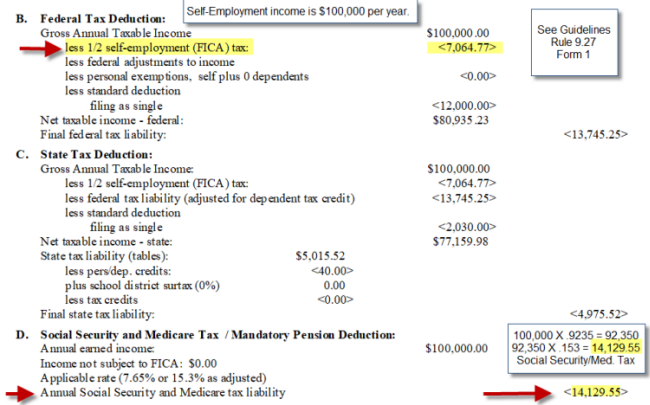
When you look at Form 1, Rule 9.27 in the Guidelines, you will see under section "B. Federal Tax Deduction" a line that says "less 1/2 self-employment (FICA) tax". This means that if you have a self-employed individual and you enter their self-employment income into the proper field, Iowa Support Master will calculate their FICA and enter half that amount on this line on Form 1. Wage earners don't receive that deduction. Where the deduction for half of FICA on Form 1 comes from is that this is the result of the fact that you’re allowed to deduct 50% of your self-employment tax when calculating the income upon which the tax will be charged. The figure is .9235.
Self-employment income can be a challenge. These folks will create all kinds of expenses to reduce their income (tax liability) and you have to ferret through the numbers. There is additional help found here that pertains to farmers but it would also apply to any self-employed person. Click Here for additional info.
The full boat rate on self-employed people is 15.3%.
Don't forget that if the kids are on Title 19, hawk-i or are not covered by health insurance, if the source of income to the NCP is not subject to a wage withholding order, they are not required to pay cash medical. See 252E.1A(4)(b) along with our many help files on this Code section.
Back to Top
What to do if a party is drawing on a pension?
You need to know what taxes are being paid on the pension. Most likely, the party is paying federal and state taxes. They would not be paying FICA. Many types of retirement income aren’t subject to FICA taxes because they aren’t considered wage income from working. For example, distributions from an IRA or 401(k) aren’t subject to FICA taxes.
Read more about how to address pensions. Click Here - Pension Help.
Back to Top
What to do if a party is contributing money into a pension?
You need to know if that party is also contributing to Social Security. If they are, then the money they are putting into a pension must be included as income to that party. You need to know what taxes are being paid on the pension contributions, if any. Go to the "Other Income" area of the income screen and in the "Describe Income" field enter "Pension Contributions" then indicate the amount being contributed. Next you must check or uncheck the boxes. If they are paying federal tax now on the contribution, then check that box. If they are not, uncheck the box, etc.
Back to Top
What is imputed income?
The court may impute income to a party if, for example, they have the ability to work full time but are only working part-time by choice. The court will assign value by inference from the value of the talent, education, experience of the party.
How do you determine a value? You will need to know what the person has been doing in their life. Do they have an education? What work experience do they have? Where have they worked? When did they last work? Was it minimum wage? Is there some reason the person is not working? If they are home taking care of kids, what kind of job can they do? What hours can they put in? Using this information, you will "lawyer" for your client.
In Iowa Support Master, you will click on the "Common Information" link then look for the "Imputed Income" item under the worksheets.
Back to Top
How to calculate the FICA Example: the person has $100,000 of net self-employment income. Use the calculation method as shown below. The key numbers are shown in bold below. The full boat rate on self-employed people is 15.3%.
1. Multiply the self-employment income by .9235. $100,000 X .9235 = $92,350. This is the amount of income that is subject to FICA tax pursuant to the IRS.
2. Next, multiply the result, $92,350 X .153 = $14,129.55 is the self-employment share of FICA tax. This is what the self-employed individual would pay in FICA.
Pull up Form 1 and scroll down the page. When you get to FICA you will see that Iowa Support Master properly calculates these taxes.
Back to Top
The problem with farmers... You cannot enter a "negative" number into the program. First off, no judge or the lawyer (for the other side) is going to buy into it.
This is one of those subjects where you could ask a dozen different lawyers how to deal with this and get 13 answers. Here is what we have gleaned from some of our friends that use Iowa Support Master when asked, how do you handle farmer income when they show a loss every year.
Usually we have a CPA review the tax returns and we determine an income for child support purposes. We have not come across any farmers that do not claim a loss every year. I am sure that doesn’t help much but that is about all you can do unless the parties can agree on a child support amount and work backwards to the farmer’s income.
I would compute income for child support on the basis of net profit shown on Schedule F, Farm Income, and add back depreciation on the equipment. Probably still in the red. Then average the last three years of net income of net loss and that should do it.
Look at depreciation to see if it is accelerated. If it is, recalculate at straight line. Look at their expenses, did they prepay next seasons rent, chemicals, seed, etc. Did they put their grain into storage and do not plan on selling it until next year or have a future sales contract where they agree to sell the crop but not get paid until delivery?
Have they bought any big purchases in the past year or two? A new truck? Get a copy of the application for credit.
 Back to Top
Voluntary Reduction in Income
When a parent voluntarily reduces his/her income or decides not to work, it may be appropriate for the court to consider earning capacity rather than actual earnings when applying the child support guideline. In re Marriage of Nelson, 570 N.W.2d 103, 106 (Iowa 1997).
You want to find out where they have worked and what kind of wages they earned. What kind of education they have. What jobs may be available locally.
Back to Top
Is Incarceration a Voluntary Reduction in Income?
No. Rule 9.11(4)(a) Incarceration is not voluntary unemployment for purposes of establishing or modifying child support.
Back to Top
Taxable Income - No FICA Here you would enter income of a party who does not pay into FICA. Rental income would be an example.
Back to Top
Military/Veteran's Disability Payments The Iowa Supreme Court has determined that veterans disability benefits are considered income when calculating support under the Iowa Child Support Guidelines. "The guidelines do not limit the definition of gross income to that income reportable for federal income tax purposes. Although veterans' disability benefits … are exempt from federal taxes, they are properly considered as income … in determining the amount of child support." In re Marriage of Lee, 486 N.W.2d 302, 305 (Iowa 1992). Veteran's disability payments are not subject to tax so you would place the income into the "Other Income" area of the income screen and uncheck all boxes.
Back to Top
Public Assistance and Earned Income Tax Credit are not considered "gross income". Do not include public assistance payments, the earned income tax credit or child support payments a party receives. Those items are not income. Reimbursement spousal support is not income. Other spousal support is considered income. See Rule 9.5(1)(b) of the Child Support Guidelines which reads..."Gross monthly income does not include public assistance payments, the earned income tax credit, or child support payments a party receives."
Back to Top
Adoption Subsidy An adoption subsidy is money received by the person(s) who have adopted children. The subsidy amount may vary depending on the circumstances of the child. For example, the subsidy is higher if the child is under a disability. A variance in support might be considered if adoption subisidies are in place.
See In re Swagel No. 04-1127. April 13, 2005. Click Here to read the Swagel decision.
“.... Jeff next contends the district court failed to account for the substantial adoption subsidies Beth receives for her four adopted children, which total some $2,600 per month, in calculating the amount Jeff owes in net child support payments. However, as Beth's brief accurately points out, income from state public assistance programs is generally exempt from child support determinations. Iowa Admin. Code r. 441-99.1(1) (2004). Subsidized adoption assistance, the type received by Beth, is specifically exempted from her income in this context. Iowa Admin. Code r. 441-41.27(6)(x) (2004). Jeff's argument on appeal is therefore without merit and the district court's determination of the parties' child support obligations is affirmed.”
Back to Top
Party Receives Child Support (prior case) This is not income and not included. Rule 9.5 of the Guideliness spells out that monthly income means "reasonably expected income". Child support is not income. It is financial assistance provided to help care for a dependent.
Back to Top
Party Receives Distributions from Trust Fund The party should receive a K-1 form from the trust. When a trust makes a distribution, it deducts the income distributed from its own tax return and issues the beneficiary a tax form called a K-1. The K-1 will tell you how much of the distribution is interest income vs. principal. The recipient must pay taxes on those funds received that are considered interest. The recipient does not pay taxes on funds that are considered principal.
br> If you are able to determine what is taxed and what is not, you would use the "Other Income" fields in Support Master.
Back to Top
Military Pay Assume you have a party who is in the military earning $60,000 per year. They pay Federal Tax/FICA but no State Income Tax comes out of their check. On the "Income Screen", look toward the lower half of the screen where you will see "Other Income". For whichever parent is in the military, you would enter "Military Pay" to describe the income. Next enter "60000" as the amount of income. Now simply uncheck the "State Tax" box. Iowa Support Master will not calculate state tax on their income.
Military Perks Assume you have a party who is in the military receiving $20,000 in value for housing, food, etc. per year. They pay no taxes on this benefit and you wish to include it as income. On the "Income Screen", look toward the lower half of the screen where you will see "Other Income". For whichever parent is in the military, you would enter "Military Benefits" to describe the income. Next enter "20000" as the amount of income. Now uncheck all the boxes. Iowa Support Master will not calculate taxes on these benefits. For more information about military perks: Click Here BAH - BAS.
Military/Veteran's Disability Payments The Iowa Supreme Court has determined that veterans disability benefits are considered income when calculating support under the Iowa Child Support Guidelines. "The guidelines do not limit the definition of gross income to that income reportable for federal income tax purposes. Although veterans' disability benefits … are exempt from federal taxes, they are properly considered as income … in determining the amount of child support." In re Marriage of Lee, 486 N.W.2d 302, 305 (Iowa 1992). Veteran's disability payments are not subject to tax so you would place the income into the "Other Income" area of the income screen and uncheck all boxes.
Back to Top
Law Enforcement/Firefighters There are some tricky issues when it comes to their income. You need to be looking at their W2 or a wage stub. We don't know if the rules are consistent across Iowa but in some cases, firefighters pay into Medicare but not Social Security. You have to do the calculations.
Here is where you need to use our "Mandatory Pension Wizard". Check out our guides for IPERS as the same rules apply to Firefighters.
IPERS in Detail
IPERS in 3 Easy Steps
Back to Top
Taxable Income Enter income that is not subject to FICA. Items include interest, interest on savings accounts, etc. It is income and it is included in the calculation of child support.
Back to Top
Wages paid in Iowa and some other state. This will require you to take a number of steps:
1. Enter the Iowa income income where it should go. Make all your entries in the program except for the out-of-state income.
2. Print the Analysis page.
3. Next compute the taxes on the out-of-state income. You need to know what taxes are applied to the out-of-state income to determine how much is paid in taxes in that state. Once you know the dollar amount of taxes are that are taken from the out-of-state income, go back to the income page and add the out-of-state income to the Iowa income in the income box.
4. Take the Analysis Page and look at the Iowa taxes that are applied to the Iowa income. Add your out-of-state tax amount to the Iowa tax amount so that you have the total tax figure.
5. Click on Calculation Overrides in Iowa Support Master and enter in the combined amount of federal and/or state tax to override what the program calculates. This will give you the correct calculation applying taxes from Iowa and the other state.
Print Form 1.
If, for example, you have a party who is working in Florida where there are no state income taxes, you would use the "Other Income" feature of Iowa Support Master. Enter the amount of their income and uncheck the "State Tax" box. That will give you the correct tax calculation.
Back to Top
Other Income This feature allows you to enter certain incomes that may be subject to certain taxes. Examples include unemployment income which is not subject to FICA. Say your client receives $15,000.00 in unemployment. You would enter "Unemployment" in the "Describe Income" box then enter the amount, such as 15000.00 in the "Amount" box then uncheck the FICA box.
Have a client who is getting checks from four different outfits? Just combine them and plug them in calling them "Multiple Sources" then when you pull up the worksheet, just edit it. Add an asterisk then at the bottom of the past page, list all the sources of income.
Pre-Tax Health Insurance If a party earns $50,000 per year but has $5,000 per year taken to apply to the cost of health insurance, pre-tax, this means that the party has $5,000 of income on which tax is not paid. Plug in $45,000 as Wage Income. Go to Other Income and enter "Pre-Tax Health" in the income description then enter 5000.00 as the amount. Uncheck all the boxes. This will add the $5,000 back into the income and no taxes will be imposed on those funds.
Back to Top
SOCIAL SECURITY - SSI - SSDI
Regular Social Security Benefits If a party is drawing regular, Social Security benefits, you would enter the amount received in the "Other Income" fields. Uncheck the "State" box as social security benefits are exempt from the Iowa state income tax. Uncheck the "FICA" box as they are not subject to FICA taxes. The reason being is that Social Security is not considered "wage income" from working.
What is SSI? is known as Supplemental Security Income. It is a program administered by the Social Security Administration to assist people with limited income who are blind or disabled. SSI payments ARE NOT considered income to the recipient for purposes of calculating child support. See Rule 9.4 of the Guidelines. SSI is akin to "welfare". See Rule 9.5(1)(b). It is paid to disabled individuals who have either never worked or who haven't earned enough work credits to qualify for SSDI.
SSI - Child what happens if a child of the parties is receiving SSI and based solely on the child's disablity? Those funds are not considered income to either parent. These funds, which are paid over to the custodian of the child, may play a role in the NCP seeking a variance in the child support amount. Section 598.1(9) provides "The obligations shall include support for a child who is between the ages of eighteen and nineteen years ..... may include support for a child of any age who is dependent on the parties to the dissolution proceedings because of physical or mental disability.. Keep reading.
Be mindful that if a parent is ordered to contribute child support for a child who is on SSI, Social Security will exclude one-third of the amount of child support payments from countable income when calculating the child's benefits. This means that the child's benefit may be reduced as a result of child support being paid for that child. It won't be dollar-for-dollar but Social Security may act to reduce the benefit paid. If the children are on SSI, the children are also eligible for Medicaid - Title 19.
What is SSDI? is a monthly benefit paid by Social Security to a person who is disabled and has worked in the past and paid into Social Security. SSDI benefits are paid to people who are unable to work for a year or more because of their disability. SSDI is considered income so you would enter the amount being received by that parent as income in the program. Makes no difference which party receives it, it is income. SSDI benefits are not taxable but there is a threshhold where such benefits do become subject to taxation. For a single person, if they receive less than $25,000 per year, their SSDI benefits are not subject to tax. You would enter this income in the "Other Income" fields and uncheck the boxes. Do see 598.22C below and do conduct your own research on this topic. It seems to change with the direction of the wind.
Are children eligible to receive SSDI benefits? Yes. A disabled person's dependent children are eligible to receive SSDI dependent benefits, called auxiliary benefits. These benefits continue until age 18 or in full-time secondary school. At age 19, the benefits stop.
If the NCP is disabled and on SSDI, the child(ren) of the NCP should also be receiving SSDI based on the NCP's disability. The NCP should receive a credit toward his/her child support obligation for the amount of monies being received by his/her children that are in the care of the CP. So if NCP has a support obligation of $600 per month and the two children combined are taking in $600 per month SSDI, which, remember, is based on the disability of the NCP, the NCP should receive credit of $600 per month and thus be required to pay $0 per month in child support. Our recommendation is to add a note to your forms about this benefit to bring it to the attention of the court. Certainly the lawyer advocating for his/her client should address this in court. For more information, see In re the Marriage of Belger, 654 N.W.2nd 902 (Iowa 2002) Click Here to Read Belger. See 598.22C below.
If the CP is disabled and on SSDI, according to 598.22C(2), dependent benefits shall be included as income to the disabled parent for purposes of calculating support. So if CP receives $1,200 per month in SSDI and the child of the parties receives $400 per month, you would add the $400 on to the CP's income of $1,200 for a total income to CP of $1,600. You need to know what taxes, if any, are taken out. If they are not, put the numbers in the "Other Income" field and uncheck the boxes.
What if a parent of a child is deceased and the child receives Social Security as a result? You would not see this in a case unless the child is in the care of a relative, perhaps, for example, in a guardianship matter. The money would be received by the guardian as the contribution by the parent toward the care of their surviving child. You would not use the income of the guardians to calculate child support, they are not the "parent" of the child. The child would not be receiving this benefit if not for the passing of the parent. When you have a deceased parent, there is no income by that parent. And the benefit the child is receiving is their contribution toward the cost of taking care of the child. We would think you might bring this up to the court to seek a variance in support. Be mindful, the guardians have no legal obligation to bear the financial burden of caring for the child.
598.22C CHILD SUPPORT -- SOCIAL SECURITY DISABILITY DEPENDENT BENEFITS.
If dependent benefits are paid for a child as a result of disability benefits awarded to the child's parent under the federal Social Security Act, all of the following shall apply:
1. Unless the court otherwise provides, dependent benefits paid to the child support obligee as a result of disability benefits awarded to the child support obligor fully satisfy and substitute for the support obligations for the same period of time for which the benefits are awarded.
2. For the purposes of calculating a support obligation under section 598.21B, the dependent benefits paid for any child shall be included as income to the disabled parent.
3. a. Any order or judgment for support for a child for whom social security disability benefits are paid to the child support obligee as a result of disability benefits awarded to the child support obligor shall include all of the following:
(1) The dollar amount of the child support obligation as calculated by application of the guidelines under section 598.21B, and a statement that the social security dependent benefits are included as income to the obligor in that calculation.
(2) The dollar amount of the social security dependent benefits paid to the obligee which shall be dollar-for-dollar satisfaction of the obligor's child support obligation.
(3) The dollar amount, if any, the obligor shall pay after application of the social security dependent benefits as a credit to or dollar-for-dollar satisfaction of the child support obligation.
b. The amount of the child support obligation stated in the order, and the amount the obligor shall pay after application of the social security disability dependent benefit credit or satisfaction stated in the order, shall continue until modified, as provided in section 598.21C.
4. The amount of any child support obligation satisfied under this section based upon the receipt of dependent benefits paid to the child support obligee as a result of disability benefits awarded to the child support obligor shall not be considered delinquent.
For more discussion and information, go to the Social Security Website http://www.SocialSecurity.gov